
Story behind Tradu
Overview
Industry : Fintech
Location: UK + Global rollout
FXCM offers global services in online foreign exchange (FX) trading, stocks, and other CFD trading. The company runs its exclusive forex and CFD platform, Trading Station, while also providing support for diverse platforms such as MT4, Ninja Trader, and ZuluTrade.
FXCM prides itself on an extensive onboarding system with multiple layers of KYC verification. The collaboration with Zensar initially began as a maintenance exercise for their onboarding application. However, the legacy application, supported on the Back Base platform, proved cumbersome, leading to a suboptimal user experience and significant latency issues. This maintenance initiative transformed into the custom development of an onboarding application, addressing the top-tier problem statements identified during the initial discovery phase.
Onboarding had to cater to 183 countries and 17 languages, requiring special attention to UI design for diverse cultures and languages.


Team A :
Focused on rebranding and UX research to simplify the overall experience which would be developed as Phase 2.
Team B :
Supported the development of the custom application which required huge back-end and integration efforts, understanding business logic and complex network of user flows, while cleaning up and reusing some of the older brand assets the client provided.
Both teams collaborated closely, sharing findings and improving designs across both phases.
Two parallel design teams were established:
Noteworthy UX enhancements in FXCM:
Ensuring User Safety:
Given the intrusive nature of the personal data collected during onboarding, it was paramount to instill a sense of trust and provide sufficient feedback on the necessity of these details.

Streamlined Interaction:
Complex interactions were simplified by grouping related elements into sections, making the process feel less burdensome and time consuming for users. Simplest and logical user flow was chosen after multiple rounds on A-B testing

Visibility of system status:
Progress indicators were prominently displayed to offer users a clear understanding of their current location within the application.

Real-time Feedback:
Utilizing color-coded indicators and clear icons facilitated intuitive user reactions, providing immediate feedback on their actions.
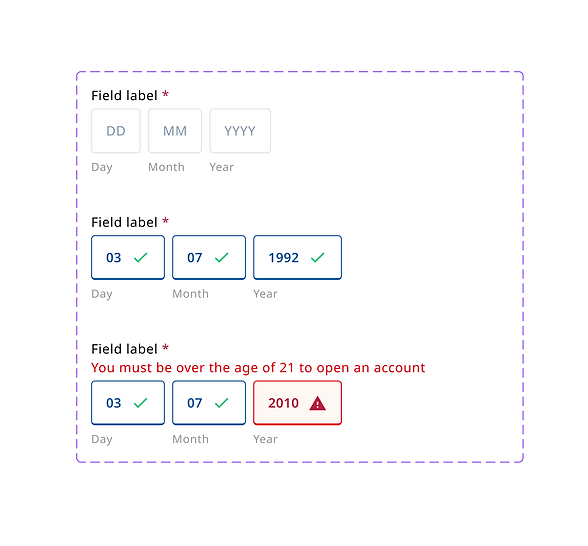
Error Tolerance:
A meticulous approach was taken to handle errors throughout the app, minimizing user frustration and ensuring a smoother experience overall.

As Phase 2 of FXCM progressed, three new projects where asked to be handled, expanding the team's scope:
1. Client Account Portal:
A user landing page for account management, fund transfers, profile updates, and document submissions.

2. E-wallet:
An electronic wallet facilitating multi-asset, multi-currency transfers and open banking payments, currently in MVP stage.

3. TRADU Onboarding:
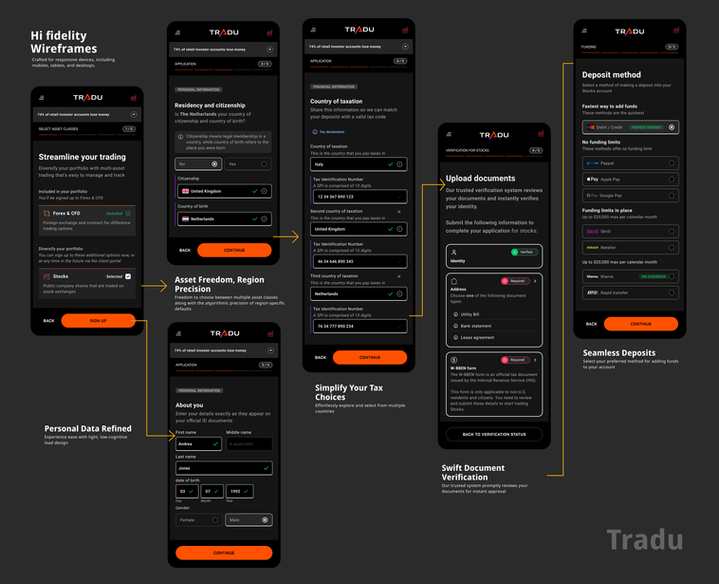
The client aimed to launch a new brand, offering a diverse range of financial assets such as CFDs, cryptocurrency, stocks, and e-wallet services. The onboarding process for these products integrated the complexity observed in CFD onboarding with additional layers of compliance and regulatory checks for other asset classes. Users were provided the flexibility to onboard multiple asset classes simultaneously or at a later date, with the option to fund their accounts multiple times.

Although Tradu Onboarding shared similarities with FXCM Onboarding, significant branding changes and complex user flows necessitated further design and development efforts. Our expanded team of 12 designers, including service, UX, UI, and content designers, rose to the challenge, ensuring parallel progress across projects.
Design system
An ever evolving design system was developed for Tradu since design and development ran even before the establishment of brand guidelines. Eventually, we transitioned the UI assets to align with the new brand guidelines, which proved to be in stark contrast to the previous ones. Although this transition required plenty of additional efforts and close collaboration between the UX and FE teams, as well as extra sprints to implement, we managed it smoothly.
Ultimately, our efforts significantly contributed to the creation of Tradu's own design system, since we were developing one of the first products launched in the ecosystem.
The range of assets included Accordions, backgrounds, graphics, alert and notification styles, micro-animations, avatars, body content styles, breadcrumbs, bottom sheets, cards, chips, dialogs/popups, headers/ progressbar styles , inputs, icons, lists, options, password styling, funds, splash screens, steppers, tabs, tables, and tags, among others.
Agile scrum
In our development process, we have adopted the Agile Scrum methodology to enhance collaboration, flexibility, and communication. The Agile Scrum, characterized by iterative development sprints, allowed us to regularly deliver incremental, functional increments of the product. We ensured efficient project management and streamlined workflows. This allowed us to adapt to changing requirements and deliverables, ensuring timely delivery of high-quality products.
Daily Stand-ups: The Scrum team holds daily stand-up meetings to discuss progress, challenges, and plans for the day. This fosters communication, transparency, and quick issue resolution.

Team
As a UX design lead, I had the privilege of working with a dynamic and diverse team comprising scrum masters, business analysts, backend and frontend developers, Salesforce specialists, and quality assurance professionals.
Working closely with business analysts, we gained valuable insights into user requirements and business objectives. This collaboration enabled us to align our design decisions with the needs of both stakeholders and end-users, ultimately enhancing the overall user experience.
The backend and frontend development teams played a crucial role in bringing our design concepts to life. By maintaining open communication channels and fostering a spirit of collaboration, we were able to bridge the gap between design and development, ensuring that our vision translated seamlessly into functional, user-friendly interfaces. Other than daily standup and scrum progress , we held regular biweekly meetings with FE team to clarify doubts on user interactions and support dev.
Integration with Salesforce added another layer of complexity, which lead us to design email templates and also provide feedback on frequency of communication sent to the user and their content.
Finally, the QA team played a vital role in ensuring the quality and reliability of our products. Many scenarios we participated in rigorous testing and feedback loops, we identified and addressed any issues or inconsistencies, ensuring a seamless user experience across all touchpoints.
Overall, the collaborative efforts of our multidisciplinary team were essential in driving innovation and delivering impactful solutions that met the needs of our clients and end-users alike.

Outcome
-
Reduced application submission time: Submission time decreased from 30 minutes to 1 day to just 5-6 minutes per user, significantly increasing efficiency.
-
Reusable components for global expansion: The organization is now better equipped to scale its operations and expand into business areas, driving growth and sustainability.
-
Tech improvements and agent desktop enhancements: These have reduced turnaround time for updates and changes related to compliance or application processes.
-
Streamlined processes: Inefficiencies in the user journey were identified and addressed, resulting in smoother processes and reduced friction points.
-
Consistent branding: The exercise ensured consistency in branding and design elements, enhancing brand recognition and trust.
-
Improved engagement: Incorporating user feedback and best practices in UX design has led to increased satisfaction and retention.
-
Enhanced Efficiency: Through digitalization, processes have been streamlined, reducing manual intervention and improving operational efficiency.
Stratos ongoing
Enhanced Data Insights: By leveraging digital technologies, the organization has gained access to valuable data insights, enabling better-informed decision-making and strategic planning.
This has lead to Continuous improvement initiatives for existing live products, while new MVP products are being developed and expanded for larger rollouts across EU, AU, and Asian continents.
Supporting products like client account portals for account management, agent workstations to streamline customer service operations, and the expansion of existing services to other silos are currently in progress, contributing to the creation of a large and ever-expanding ecosystem


Reaserch | Testing

Accesibility | Studio Project
